
The paper's history is the story of an invention that changed the world. From its humble beginnings in China to its propagation around the globe, paper has been an essential catalyst for culture, education, and scientific progress. As a medium for knowledge and communication, paper played a pivotal role in the development of human civilization. Unlike other writing materials such as papyrus, amate, and parchment, whose influence remained local due to the limited availability of certain plant fibers and the inconvenience of transporting certain formats, paper conquered the world in the Middle Ages through an exchange network known as the paper route.
THE MAIN STAGES OF PAPER PRODUCTION
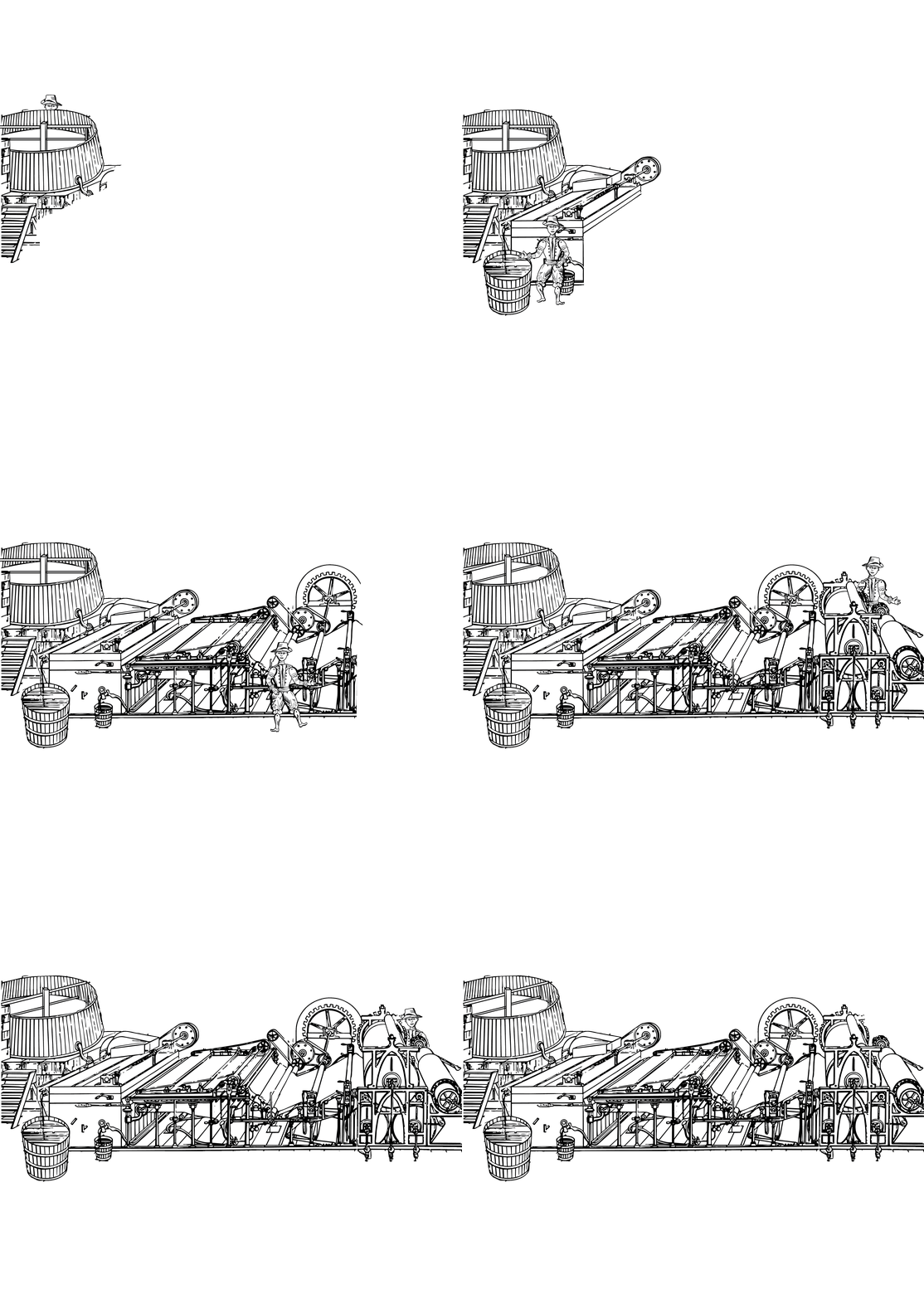
Preceded by preliminary sorting and delining phases, these first two preparation phases consist of transforming raw materials into a soft, moist pulp necessary for paper production. Using mechanical and chemical processes, washing to remove impurities, followed by refining through grinding, improves the quality of the fibers and produces a soft, workable pulp.
Often preceded by a chemical bleaching phase that began in the late 18th century, various glues were developed over time to ensure fiber adhesion. Whether animal-based, plant-based, or simply water-based, these binders consolidate raw materials to form a coherent and homogeneous substrate. In a way, the glue defines two of the important physical characteristics of paper as a medium: elasticity and durability.
Using manual or mechanical pressing, either vertical or rotary, the pulp, together with its binding agent, is transformed into a thin layer comparable to a sheet. By removing moisture and strengthening the cohesion of the fibers, this stage transforms a soft, almost liquid material into a solid yet fairly pliable medium. This phase is followed by another phase, that of drying. Through simple exposure to air and sunlight, or by passing through a series of heated cylinders, the sheet obtained is dehumidified to achieve its final texture.
The finished paper is then cut to size to freely dimension the final product. This definition phase also ensures the finishing of this medium by correcting the irregular edges of the finished paper. A final phase, emblematic of the turn of the century in question, was winding using large reels. A compaction technique that did not previously exist in manual craft production, winding or reeling was developed to protect the appearance of this rather fragile product during transport to associated industrial units, where it underwent further processing such as binding or printing.
THROUGH THE INDUSTRIALISATION GLASS, AND WHAT CHARTA FOUND THERE


Bibliography
-
FEBVRE Lucien, MARTIN Henri-Jean, « La question préalable : l'apparition du papier en Europe », dans L'apparition du livre, Paris, Éditions Albin Michel, coll. « L'évolution de l'humanité », 1971, p. 39-60
-
Royal Museum of Mariemont, Le Papier. Techniques De Fabrication Hier Et Aujourd'hui, Bibliothèque Mariemont, 1981
-
ORSENNA Erik, Sur la route du papier, Paris : Librairie générale française, 2013