From Manuel to Mechanized
As highlighted in the catalog for the exhibition L’Aventure des écritures (The Adventure of Writing), before mechanization, paper was made by hand using a demanding, slow, and highly specialized craft that required codified movements and a human production line. This production cycle, which could take several weeks, made paper expensive, limited in terms of distribution, and reserved for official, religious, or scholarly uses.
The gradual mechanization of the production phases made it possible to gradually increase yields by replacing the slow human labor of the craftsman with his tools with the efficiency of various machine tools, including the Dutch pile. However, the machines were still fed manually.
The industrialization of paper production reached its peak in terms of mechanization with the invention of the continuous paper production machine. This huge, electrically powered machine made it possible to carry out the entire process without any human intervention and with uninterrupted production.

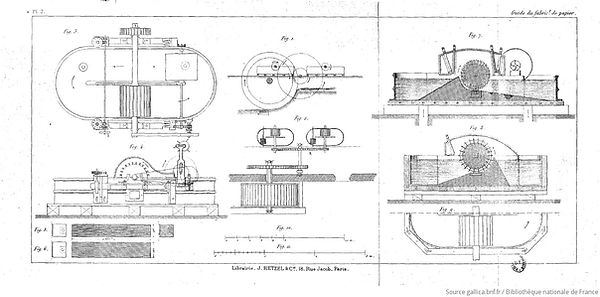

PL 4: PLATE IV - Handmade paper production - Work vats and accessories - Various devices used in vat paper production.
PL 2: PLATE II - Cylinders used in paper production for pulping.
PL 3: PLATE III - Assembly of an advanced paper machine. (LARGE MODEL)
PROUTEAUX Albert, Practical Guide to Paper and Cardboard Manufacturing (New Edition), J. Hetzel, Paris, 1885


