
Manufacture impériale de Saint-Pétersbourg, 1870

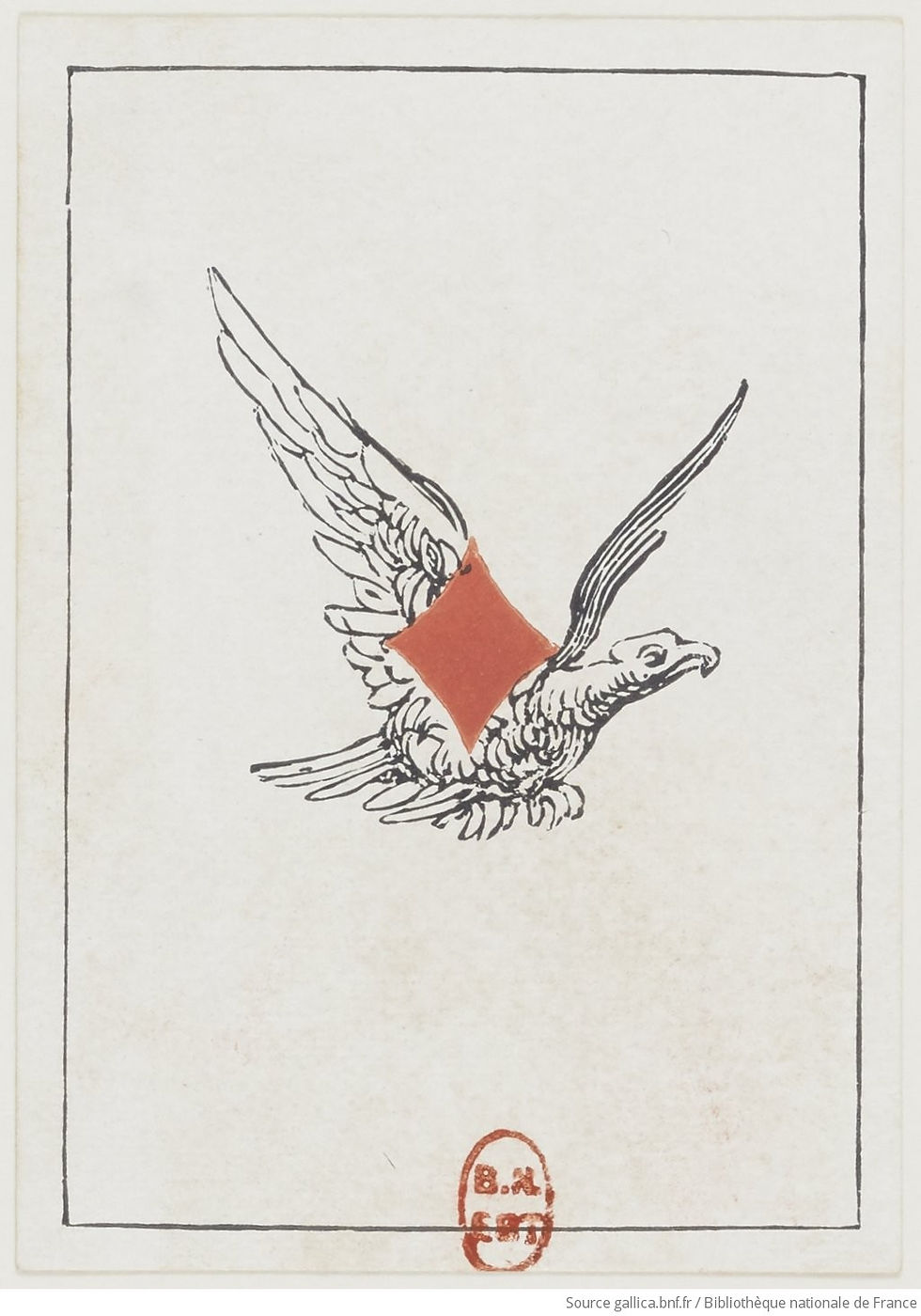
Manufacture impériale de Saint-Pétersbourg, 1870
Apart from number cards and playing cards depicting human figures, since the end of the 19th century, other allegorical and fantastical representations have appeared on certain cards. Examples include the addition of animal figures and various scenography.

CARDS AND GAMES
Playing cards, board games, interactive origami, or foldable game boards made of paper has been at the heart of play for centuries. A lightweight, accessible, and universal material, it enabled the spread of entertainment long before the digital era. The earliest known playing cards, such as the leaf game or madiao, date back to the 9th century and appeared in China during the Tang dynasty.
Originating in China and spreading via the Silk Road, the cards reached the Arab world before being introduced to Europe through merchants. During the medieval period, European games and cards were handmade on laid paper and then illustrated using painting or engraving techniques. These leisure papers became true popular works of art.
By the turn of the 20th century, the evolution of the paper industry, the mechanization of printing, and the wider dissemination of paper significantly contributed to the development of games. Coupled with major social changes linked to the industrialization of cities, new representations: less classical, more playful, and sometimes even grotesque or caricatural, emerged.
Various Games, 1903 Catalogue of the French Arms and Cycles Factory of Saint-Étienne, National Library of France.
![[Recueil_Catalogues]_Année_1903___[._edi](https://static.wixstatic.com/media/243e7c_85bfb7c82a9c461f9f1d22733d444b4a~mv2.jpg/v1/crop/x_0,y_83,w_931,h_1401/fill/w_319,h_480,al_c,q_80,usm_0.66_1.00_0.01,enc_avif,quality_auto/%5BRecueil_Catalogues%5D_Ann%C3%A9e_1903___%5B__edi.jpg)


Bibliography
-
ALLEMAGNE Henry-René d', Les cartes à jouer du XIVe au XXe siècle, Paris, Hachette, 1906
-
BEAUBLE Claude Louis, Étrennes aux gens d'esprit ou jeu récréatif composé de 72 cartes et d'un texte explicatif sur la manière de le jouer, Paris, chez Beaublé fils, graveur, cour des Fontaines, 1807